






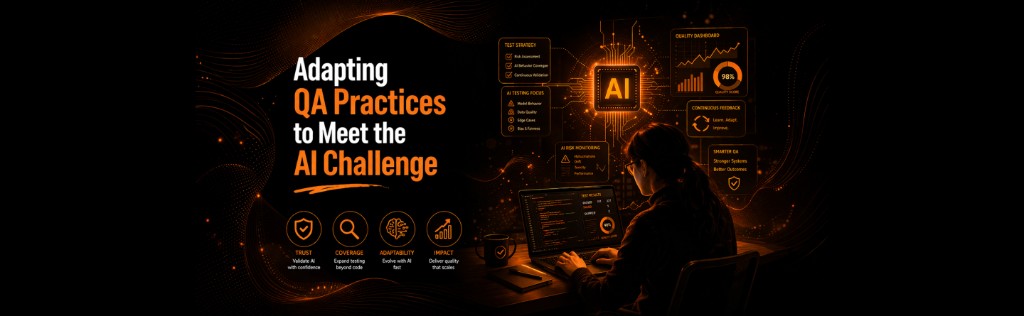
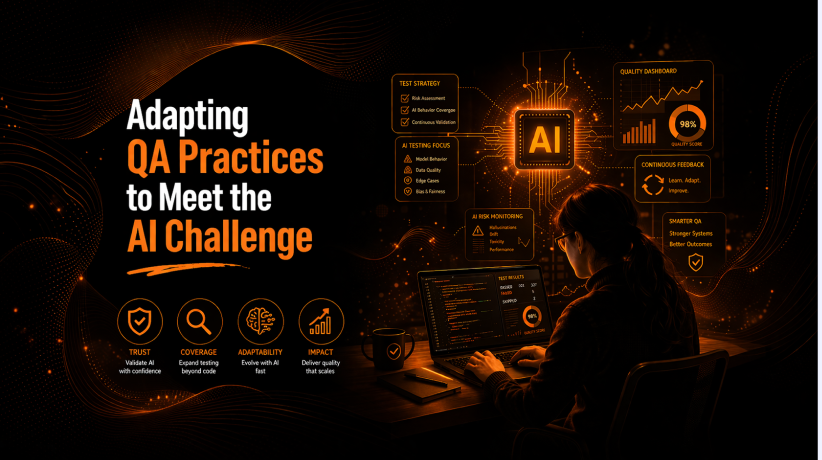
For years, quality assurance has lived at the end of the software delivery pipeline. Teams would plan, design, and build a product, then hand it off for testing before release. This model worked reasonably well when development cycles were measured in months and change requests were infrequent. But in the AI era, where development velocity is accelerating and the complexity of software systems is growing, treating quality as a final checkpoint is no longer sufficient. The discipline needs to evolve — from Quality Assurance to Quality Engineering — and it needs to be embedded across every phase of the product lifecycle.
At Ballast Lane Applications, we have been rethinking what this evolution looks like in practice. The answer is not simply about adopting new tools. It is about changing how product, design, and engineering teams collaborate, and how quality thinking is woven into every stage of the work.
Shared Discovery: Quality Engineering Starts Before the First Line of Code
The most effective quality engineers are not waiting for a finished product to test. They are present during discovery, contributing context that shapes whether a feature is even testable, maintainable, and reliable from the start.
During the discovery phase, quality engineers bring a distinct lens to the conversation. They identify risk areas early — parts of the system where complexity, ambiguity, or external dependencies are likely to produce defects. They raise testability concerns before an architecture decision becomes difficult to reverse. They ask the questions that uncover edge cases no one else thought to consider: What happens when the network is slow? What does the system do when a third-party service returns unexpected data? What does failure look like for the end user, and how will it be detected?
During design, quality engineers validate user flows by thinking through the full range of scenarios a real user might encounter. This is not about blocking design decisions, but about making them more resilient. A well-designed flow accounts for error states, empty states, and boundary conditions — and quality engineering expertise helps ensure those considerations are part of the design process rather than discovered during testing.
During development, the role shifts again. Quality engineers work alongside developers to write automated tests as features are built, ensuring that test coverage grows with the codebase rather than trailing behind it. This collaborative approach reduces the cost of defects, because catching a problem during development is far less expensive than catching it in a staging environment or, worse, in production.
Post-release, the work does not stop. Quality engineers monitor production quality, track anomalies, and feed observations back into the team's planning process. Patterns in production defects often reveal underlying process gaps that can be addressed systematically, preventing entire categories of issues in future releases.
Expanding AI's Role in Quality Engineering
AI tools are changing what is possible in quality engineering, and teams that embrace these capabilities thoughtfully will have a meaningful advantage. The key word is thoughtfully — AI in quality engineering is most effective when it augments human judgment rather than replacing it.
One of the most valuable applications is in test scenario generation. Quality engineers can use AI to analyze product requirements and generate comprehensive test scenarios, including edge cases and negative paths that might otherwise be overlooked. This is particularly useful in fast-moving environments where the volume of changes makes manual scenario planning difficult to scale.
AI also helps teams focus their testing efforts more effectively by identifying high-risk areas in code changes. Rather than running the full regression suite on every deployment, intelligent tooling can assess which parts of the codebase have been modified and which areas of functionality are most likely to be affected, enabling more targeted and efficient testing.
Synthetic test data generation is another area where AI delivers real value. Creating realistic, representative test data has historically been time-consuming and, in regulated industries, fraught with privacy concerns. AI can generate synthetic data sets that mirror production patterns without exposing sensitive information, making it easier to test complex scenarios without the compliance risks associated with using real data.
In production, AI-powered anomaly detection enables teams to identify quality issues before users report them. By analyzing patterns in system behavior, error rates, and user interactions, these tools can surface signals that would be invisible to manual monitoring at scale. This closes the feedback loop between production and the development team in a way that was simply not possible with traditional monitoring approaches.
Finally, AI is transforming regression testing. Intelligent test selection, combined with automated maintenance of test suites, reduces the burden of keeping regression coverage current as the codebase evolves. This is a meaningful improvement for teams that have struggled with brittle test suites that require constant manual upkeep.
Measurable Outcomes: What Continuous Quality Engineering Delivers
The case for embedding quality engineering across the product lifecycle is not theoretical. Organizations that have made this shift report concrete, measurable improvements in how software is delivered.
Defect leakage to production decreases when quality thinking is present earlier in the process. Problems that once survived to production are caught during discovery, design, or development, where they are less costly to resolve and less disruptive to users. Feedback cycles between teams become faster because quality engineers are part of the conversation from the start rather than being brought in at the end when options are limited.
Regression risk with each release drops as automated test coverage grows alongside the product rather than struggling to catch up with it. And across the organization, release confidence improves. Teams move faster not because they are cutting corners, but because they have built the processes and tooling that give them genuine confidence in what they are shipping.
These outcomes matter not just for engineering teams but for the business as a whole. Higher release confidence means shorter time to market. Lower defect leakage means fewer customer-facing incidents and reduced cost of support. Faster feedback cycles mean product decisions are informed by better data and fewer surprises.
The Future of Product Delivery
AI is accelerating development velocity in ways that would have been difficult to imagine just a few years ago. Features that once took weeks to build can now be prototyped in days. Codebases that once required large teams to maintain can be managed more efficiently with intelligent tooling. The pace of change is not slowing down.
But velocity alone does not determine quality. The organizations that will thrive in this environment are not simply the ones that adopt AI tools the fastest. They are the ones that pair those tools with the disciplined, cross-functional collaboration between product, design, and quality engineering that ensures what gets built is actually what users need, and that it works reliably when it reaches them.
Quality Engineering, embedded across every phase of the product lifecycle, is what transforms AI-accelerated development from a source of risk into a genuine competitive advantage. The teams that internalize this — that treat quality as a shared responsibility rather than a final gate — will be the ones that consistently deliver software their customers trust.
At Ballast Lane Applications, this philosophy shapes how we staff and structure our delivery teams. Quality engineers are not an afterthought. They are partners in discovery, design, and development, and their expertise is one of the most important factors in whether a product succeeds. In the AI era, that has never been more true.